-
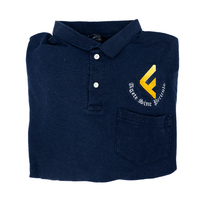 Long Sleeve T-Shirt
 På Oliver Williamsons tröja återfinns ett motto "agete sine periculo", vilket betyder "agera försiktigt".
Oliver Williamson donerade tröjan till Nobelprismuseet 2009.
-
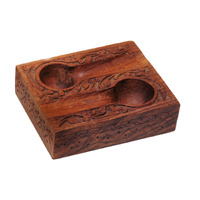 Pipe holder
 The pipe holder was Oliver Williamson's companion when he wrote one of his major works, Transaction Cost Economics, during the 1970s.
Oliver Williamson donated the pipe holder to the Nobel Prize Museum in 2009.
-
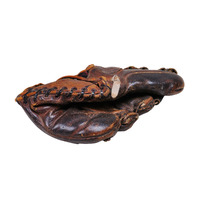 Baseball mitt
 Baseball was a sport dear to Oliver Williamson's heart. The mitt also had a special meaning to him because baseball taught him a lot about the importance of teamwork.
Oliver Williamson donated the baseball mitt to the Nobel Prize Museum in 2009.
-
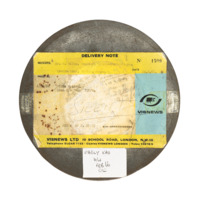 Film reel
 The film, from 1966, shows Charles Kao during his early experiments with optical fibres conducted at the British telecom company Standard Telecommunication Laboratories.
Kao's findings from the experiments were that optical fibres could be used for efficient transfer of information, if only the glass they were made of could be purified. This was eventually made possible, and a large part of our communication today is through optical fibres.
The film was donated to the Nobel Prize Museum by Richard Epworth at Standard Telecommunication Laboratories when Kao was awarded the Nobel Prize in Physics in 2009.
-
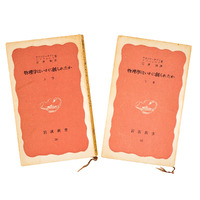 Book by Albert Einstein and Leopold Infeld
 The Evolution of Physics is a popular science book by Albert Einstein and Leopold Infeld. Reading a Japanese edition of it as a high school student it inspired Makoto Kobayashi to pursue the study of physics.
Makoto Kobayashi donated the books to the Nobel Prize Museum in 2009.
-
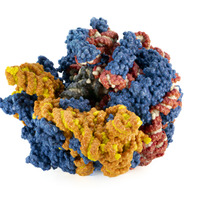 Model of a ribosome
 This model represents a ribosome. The ribosomes in our cells are where one of the most fundamental processes in the chemistry of life takes place: the production of proteins based on the genetic information in RNA molecules.
The highly complex ribosome structure could be mapped thanks to the efforts of many scientists, including Thomas Steitz, Venkatraman Ramakrishnan and Ada Yonath.
Thomas Steitz donated the model to the Nobel Prize Museum in 2009.
-
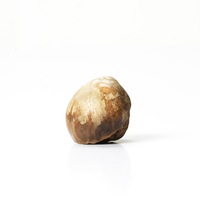 Seed of a Tambalacoque tree
 Can an authorship be symbolised by a nut? Jean-Marie Gustave Le Clézio picked this nut from one of the few surviving tambalacoque trees on the island of Mauritius. According to legend, the seeds of this tree were once spread via the droppings of the dodo. When the Europeans arrived on the island in the 1600s, all the dodos were gradually killed and the seeds of the tambalacoque tree could no longer germinate. Le Clézio often writes about the encounter of Western and other cultures. He is often critical of the way Europeans have treated peoples in other parts of the world.
Jean Marie Gustave Le Clézio donated the nut and the letter to the Nobel Prize Museum in 2009.
-
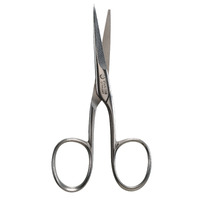 Nail scissors
 These scissors suggest an experimental approach to writing poetry. When she is not writing novels, Herta Müller creates poetry in the form of collage. She cuts out words and phrases from printed texts and arranges them in new combinations and images.
The nail scissors were used when she first began creating her collages. When a travelling cutler came to Müller's neighborhood, she left her scissors with him for sharpening. However, when he returned the scissors, one of the blades was crooked. When her husband tried to bend it back into shape, it broke off. In despair, she began searching for a new pair.
Herta Müller donated the scissors to the Nobel Prize Museum in 2009.
-
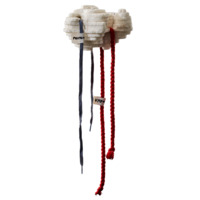 Model of a ribosome
 The model is a simplified representation of a ribosome – one of many refined and complex structures found in our cells. A ribosome consists of hundreds of thousands of atoms. Mapping all of their positions in detail was generally considered impossible when Ada Yonath began her work. But it wasn't!
In this model, the red string represents an mRNA molecule, which transfers the genetic code to the ribosome. The blue string represents a protein produced by the ribosome.
Ada Yonath donated the model to the Nobel Prize Museum in 2009.
-
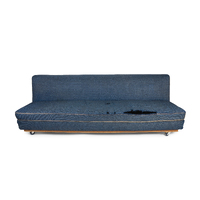 Sofa
Sofa This worn sofa had a central place in Alva and Gunnar Myrdal's home.
The Myrdals began their life together when they were young. When they met in 1919, Gunnar was 20 and and Alva 17. They married in 1924. In the 1930s, they collaborated on several important projects. Their most famous work is the book Crisis in the Population Question, which had a major impact on public debate and social policy. Alva and Gunnar Myrdal's joint efforts continued even as their careers went in different directions. Did they sit on this sofa when discussing their work?
The sofa was donated to the Nobel Prize Museum in 2009 by Alva and Gunnar Myrdal's family.
-
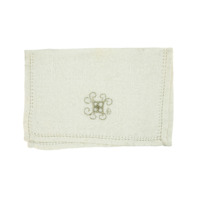 Embroidered linen napkin
 This napkin was meticulously hemmed and embroidered by Alva Myrdal. Sewing was a valuable and relaxing pastime for her, and she kept on doing it well into her old age.
The napkin was donated to the Nobel Prize Museum by the Myrdal family in 2009.
-
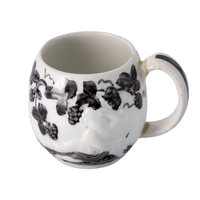 Mug
Mug This mug often stood on Alva Myrdal’s desk, including while she was working on the book The Game of Disarmament.
The mug was donated to the Nobel Prize Museum by Alva Myrdal's family in 2009.
-
 Typewriter
 This typewriter was used by Alva Myrdal while working on her book The Game of Disarmament, published in 1976.
A typewriter is associated primarily with writing and solitary thinking. These were also aspects of Alva Myrdal's life, although much of her work took place with an audience and at the negotiating table. With a background in psychology, sociology, and pedagogy, Alva Myrdal focused in the 1930s on family policy and social policy. From the 1950s, her career became increasingly international. She had several assignments for the UN. In particular, she engaged in peace and disarmament issues. As the leading Swedish delegate to the Disarmament Conference in Geneva (1962-1973), she worked to diminish the arms race between the superpowers. In addition to her involvement in peace efforts, she also worked intensely for gender equality.
The typewriter was donated the to the Nobel Prize Museum by the Myrdal family in 2009.
-
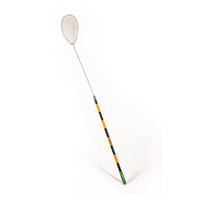 Net
Net Osamu Shimomura and his colleagues used this dip net to capture large numbers of the jellyfish Aequorea aequorea to extract a substance that makes their edges luminous. The net was made in 1968 and was designed to be light and easy to drag through water. The jellyfish had to be captured in the right direction to avoid damaging their edges. The handle was painted black and orange, the colours of Princeton University.
Osamu Shimomura donated the net to the Nobel Prize Museum in 2009.
-
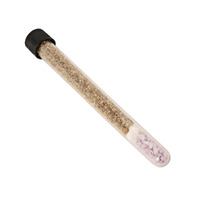 Test tube with dried Cypridina
 Osamu Shimomura's research on luminous biological substances started with the small, shelled organism Cypridina hilgendorfii. The test tube contains dried specimens of the organism.
When the sand-like material is moistened, it becomes luminous. The material was collected by Japanese soldiers during the Second World War to make discreet sources of light. At the end of the war, the U.S. Navy took over the material, and it eventually ended up at Princeton University.
These luminous shelled organisms also caught the interest of Japanese researchers after the war. In 1955, the young chemist Osamu Shimomura was given the task of discovering why these animals were luminous. After extensive work, he managed to find the cause: a luminous protein. Shimomura would later pursue his research on luminous biological substances at Princeton University.
Osamu Shimomura donated the test tube to the Nobel Prize Museum in 2009.
-
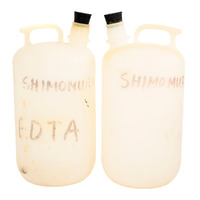 Plastic containers
 These plastic containers were used by Osamu Shimomura and his colleagues to extract luminous substances from the jellyfish Aequorea aequorea. The containers held solutions of ammonium sulphate and the acid EDTA.
From thousands of jellyfish, Shimomura and his colleagues managed to extract a few grammes of a luminescent protein, aequorin. They also succeeded in extracting small amounts of another protein that creates a pale green light. This discovery of green fluorescent protein (GFP) would have a great importance for research. GFP enables the study of processes inside the cells of living organisms.
Osamu Shimomura donated the plastic containers to the Nobel Prize Museum in 2009.
-
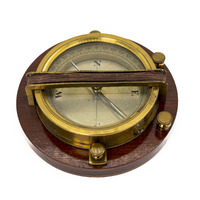 Compass
 Alfred Nobel's compass.
-
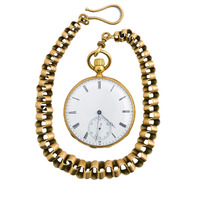 Pocket watch
 Alfred Nobel's pocket watch was certainly important in his life. Travel and meetings characterized a large part of his life and required a reliable watch.
-
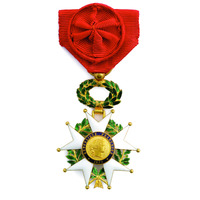 Insignia of the Legion of Honour
 Receiving the Legion of Honour served as confirmation of the position Alfred Nobel had reached in France. Nobel expressed multiple times that he did not personally consider the honors and awards particularly important, but he saw the business value associated with such recognition. At heart, he was perhaps also flattered at this evidence of appreciation.
-
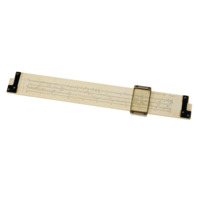 Slide rule
 Toshihide Maskawa first began using this slide rule as a high-school student. At the age of 17, he used it just after the launch of the first-ever satellite, Sputnik, in 1957, to calculate the trajectories of satellites and rockets, for example. Maskawa later delved deeper into the mathematics of quantum physics. In 1973, Maskawa got his first programmable calculator, and his slide rule was allowed to retire.
Toshihide Maskawa donated the slide rule to the Nobel Prize Museum in 2008.
-
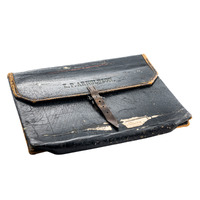 Briefcase
 This briefcase belonged to the writer and politician Klas Pontus Arnoldson, who worked to promote peace. As a member of the Swedish parliament, he advocated a policy of neutrality, that is, of declining to take sides with any party in armed conflicts. In 1883, Arnoldson founded the Swedish Peace and Arbitration Society (SPAS), and became its first secretary.
The briefcase was donated the to the Nobel Prize Museum by Klas Pontus Arnoldson’s family in 2008.
-
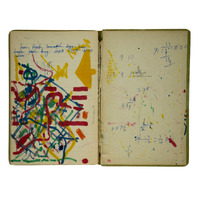 Notebook
 A notebook kept by Roger Tsien when he was eight years old gives us insights into his view of the world and how his interests evolved during his childhood years. The notebook contains lists of countries and major cities, and drawings of complicated traffic junctions and famous bridges, which fascinated young Tsien. His father's work in the air force is also reflected in his lists of plane models. Tsien’s blossoming interest in chemistry is evident in the lists of basic elements, minerals, vitamins, and medicines, and in the many sketches of chemistry experiments he copied from a book. Some pages are filled with Chinese words, although Tsien found this quite boring.
Roger Tsien donated the notebook to the Nobel Prize Museum in 2008.
-
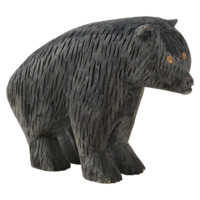 Wooden bear
 For a long time this wooden bear stood on the writing desk from which Martti Ahtisaari, as President of Finland, diplomat, and peace negotiator, worked to promote a more peaceful world. It was a gift to him from disabled soldiers injured during the Russo-Finnish War of 1939 to 1940. The bear was made by war veteran Väinö Kekkonen from Karelia, the district from which Ahtisaari was forcibly evicted as a small boy during the war. The lives of the disabled soldiers who tried to defend Karelia did not always turn out as well as Ahtisaari’s life. “The bear symbolizes Finland. And perhaps also me,” explained Ahtisaari.
Martti Ahtisaari donated the wooden bear to the Nobel Prize Museum in 2008.
-
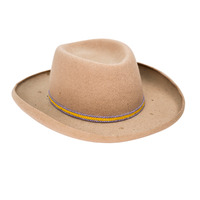 Hat
Hat This hat belonged to Gunnar Myrdal. It is a wide-brimmed felt hat, and he wore it in the 1960s.
The hat was donated to the Nobel Prize Museum by the Myrdal family in 2008.
-
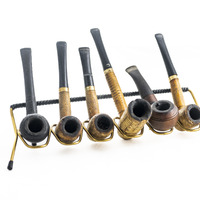 Smoking pipes in a rack
 This pipe rack and its pipes belonged to Gunnar Myrdal. He had them during his time as head of the Institute for International Economic Studies, which used to be in the Wenner-Gren Center in Stockholm. The IIES was founded in 1962, when a professorship was created especially for Gunnar Myrdal. He was its director until 1967.
The pipes and the pipe rack was donated to the Nobel Prize Museum by Gunnar Myrdal’s family in 2008.
-
 Notes
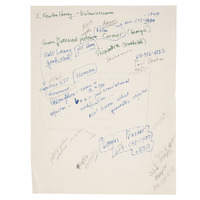
Notes This paper contains notes from a seminar that was crucial to Martin Chalfie's research.
In the late 1980s, “Neurolunch” seminars were held every Tuesday at 12.00 pm at the Department of Biological Sciences, Columbia University. On 25 April 1989, Paul Brehm held a presentation on bioluminescent organisms that was pivotal to Martin Chalfie’s research. Chalfie realised the possibility of using green fluorescent protein as a marker for gene expression in his research. His notes are scribbled on this paper, including names of scientists in the field. One of them is “Shimomura”. Osamu Shimomura, Roger Tsien and Martin Chalfie later shared the 2008 Nobel Prize in Chemistry.
Martin Chalfie donated the notes to the Nobel Prize Museum in 2008.
-
 Foundation by Isaac Asimov
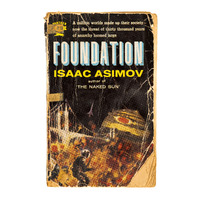
 Roger Myerson read Isaac Asimov's science fiction novel _The Foundation_ when he was twelve years old. The book inspired him to later pursue a career in mathematical social science.
Roger Myerson donated the book to the Nobel Prize Museum in 2007.
-
 Manuscripts
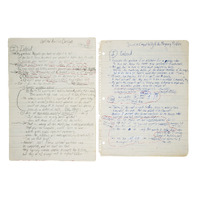
 These manuscripts are the handwritten originals of two of Roger Myerson's most seminal scientific publications: "Incentive Compatibility and the Bargaining Problem" from 1979, and "Optimal Auction Design" from 1981.
Roger Myerson donated the manuscripts to the Nobel Prize Museum in 2007.
-
 Model of RNA polymerase
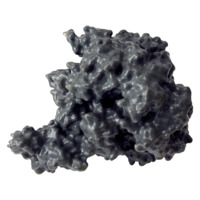
 This model, donated by Roger Kornberg, shows the structure of RNA polymerase, a molecule that plays an important role in one of life’s most fundamental processes. The molecule is an enzyme, a substance that speeds up chemical processes. This particular enzyme is active in transferring genetic information stored in DNA molecules to RNA molecules. Through a kind of bubble in the RNA polymerase molecule, a long RNA molecule is assembled. The sequence of the RNA chain’s component parts is determined by a DNA molecule, which is translated inside the RNA polymerase molecule's cavity.
Roger Kornberg donated the model to the Nobel Prize Museum in 2006.
-
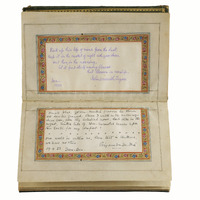 Booklet
 Some objects have a remarkable history. This small book contains the thoughts and poems of Rabindranath Tagore and members of his family. Among them are a hand-written poem by Tagore, who gave the book to Andrée Karpelès Hogman in 1923. Andrée Karpelès was an artist from France who spent a few years in Santiniketan, where Tagore ran a school. It was there that she both painted and translated Tagore's poems into French. After the end of the Second World War, Karpelès and her husband adopted a girl who had lost her father while fleeing from the Nazis, and her mother in a concentration camp. The book later became the property of their adopted daughter, Flora Hogman, who eventually settled in New York. When one of the Nobel Prize Museum's staff, Margrit Wettstein, came into contact with Flora Hogman in the course of her research, Hogman offered to donate the book to the Nobel Prize Museum. The book was given to the museum in 2007.
-
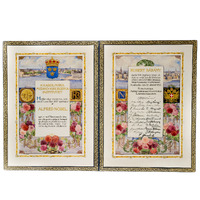 Robert Bárány's Nobel Prize diploma
 Robert Bárány was awarded the 1914 Nobel Prize in Physiology or Medicine. His Nobel Prize diploma was designed by artist Anna Berglund.
The diploma was donated to the Nobel Prize Museum by the Bárány family in 2007.
-
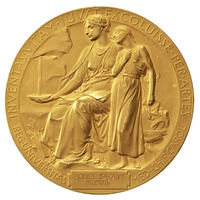 Robert Bárány's Nobel Prize medal
 Robert Bárány was awarded the 1914 Nobel Prize in Physiology or Medicine.
Bárány's Nobel Prize medal was donated to the Nobel Prize Museum by his family in 2007.
-
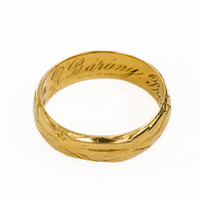 Doctoral ring
 This doctoral ring belonged to Robert Bárány, who received an honorary doctorate at the Karolinska Institutet in 1924. In the Scandinavian countries, a doctor is traditionally entitled to wear a ring, which symbolizes the bond between the doctor and science.
The ring was donated to the Nobel Prize Museum by Robert Bárány's family in 2007.
-
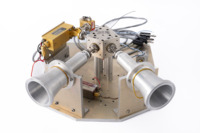 Antenna prototype
 This instrument is a prototype intended for the COBE satellite, which was used to measure cosmic background radiation. George Smoot and his research team were able to use data from the COBE in 1992 to show minor variations in radiation from different directions. This was a clue to how stars and other celestial bodies were created.
The variations can be explained by quantum fluctuations which cause particles to form lumps in the universe. These then continued to grow due to gravity.
The antenna prototype was presented to the Nobel Prize Museum in 2006 by George Smoot and NASA.
-
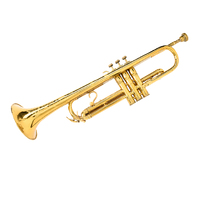 Trumpet
 Edmund Phelps learnt to play the trumpet as a teenager, and it became his passion. Music gave him a creative outlet. A course in which he was asked to improvise using a C major scale helped Phelps realise that all of us can find inspiration where least expected. Phelps played in various groups and was happy to take the lead. Would he perhaps become the head of an organisation? Phelps came to the conclusion that he was not talented enough for a career in music and chose to study humanities. But he did attend one course in economics. This sparked his interest and was the first step in his research career in economics. Phelps continued to entertain friends and family with his musical talents, including singing.
Edmund Phelps donated the trumpet to the Nobel Prize Museum in 2006.
-
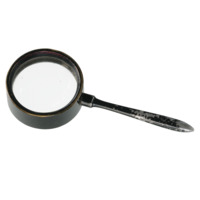 Magnifying glass
 A magnifying glass is often found on a researcher's workbench. This particular magnifying glass often lay on the writing desk of Arne Tiselius. What did he use it for? Probably for a variety of purposes. Perhaps it was used to examine chemical samples or details of his laboratory equipment. Or to examine diagrams generated by the electrophoresis analytical method Tiselius developed.
The magnifying glass was donated to the Nobel Prize Museum in 2009 by Birger Drake, a former colleague of Arne Tiselius.
-
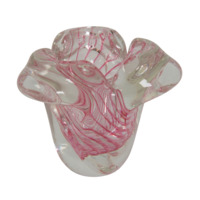 Venini vase
 Nelly Sachs gave this Venini vase to artist Lenke Rothman some time between 1951 and 1957.
Small, beautiful things gave Nelly Sachs comfort and inspiration in her work. Sachs was born into a Jewish family in Berlin and lived there until she fled Nazi persecution on the last passenger flight out in 1940. Sweden and a Stockholm apartment furnished with books and trinkets became her new home.
The vase was donated to the Nobel Prize Museum by Lenke Rothman in 2006.
-
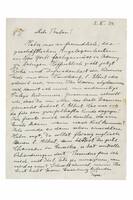 Letter from Albert Einstein to his sons
 The announcement that Albert Einstein had been awarded the 1922 Nobel Prize in Physics came as no surprise to him. Following his divorce from Mileva Maric in 1919, Einstein had promised that he would give her and their two sons his prize money if he was awarded the Nobel Prize. In this letter written by Einstein to his two sons in 1924, he mentions one of the uses to which they put the prize money: a house.
-
 Sample jar
 It was long thought that stress was the main cause of gastric ulcers. Barry Marshall had a different theory. He suspected a bacterium, Helicobacter pylori, that colleague Robin Warren had discovered in peptic ulcer patients. He was unable to prove it, however, and his theory met with resistance. Facing such opposition, Marshall decided to experiment on himself. After drinking Helicobacter pylori in a broth solution from the sample jar seen here, he contracted a serious infection. This proved his theory to be correct.
Barry Marshall donated the sample jar to the Nobel Prize Museum in 2005.
-
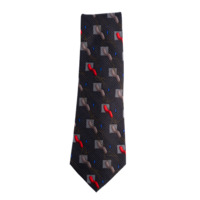 Necktie
 This necktie, which belonged to Barry Marshall is printed with the Helicobacter pylori bacteria. Marshall and Robin Warren discovered that this is the bacteria that causes stomach ulcers. They were rewarded with the Nobel Prize in Medicine in 2005 for this discovery, which was a major breakthrough in the treatment of ulcers.
Barry Marshall donated the tie to the Nobel Prize Museum in 2005.
Barry Marshall donated the tie to the Nobel Prize Museum in 2005.
-
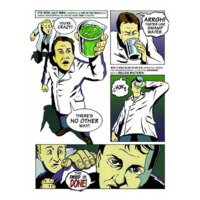 Comic book
 I serietidningen berättas historien om hur Barry Marshall upptäckte att magsår orsakas av en bakterie. Han bevisade sin hypotes genom att dricka en bakterielösning. Tidningen togs fram av läkemedelsföretaget Abbott, som tillverkade det vanligaste läkemedlet mot magsår.
Barry Marshall donerade serietidningen till Nobelprismuseet 2005.
-
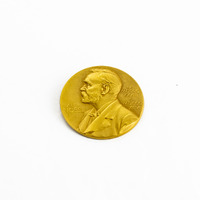 Hans von Euler-Chelpin's Nobel Prize medal
 This Nobel Prize medal belonged to Hans von Euler-Chelpin, who was awarded the Nobel Prize in Chemistry in 1929 for his studies of the fermentation of sugars. He shared the prize with Arthur Harden.
Hans von Euler-Chelpin was born in Germany, where he embarked on a career in science. He moved to Sweden as a young scientist and became a professor at Stockholm University in 1906. He held a key position in biochemistry and was a member of the Nobel Committee for Chemistry in 1929–1946.
von Euler became a Swedish citizen in 1902 but retained his German citizenship and was an officer in the German artillery and air force during the First World War. When the Nazis took over, and during the Second World War, he assisted the Nazi regime. He was an active member of pro-Nazi Swedish-German organisations and had connections high up in Nazi Germany.
The medal was donated to the Nobel Prize Museum by Hans von Euler's family in 2005.
-
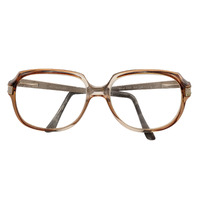 Glasses
 Glasses are commonly found among the personal possessions of Nobel Prize laureates. These glasses belonged to John Eccles.
The glasses were donated to the Nobel Prize Museum by John Eccles’ family in 2004.
-
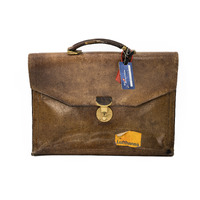 Briefcase
 This briefcase must certainly have accompanied John Eccles on some of his many trips to meet with colleagues around the world. Eccles was originally from Australia, although he lived for long periods in England, New Zealand, and the US. His last years werespent in Switzerland. Attached to the briefcase is a card from a Swiss airline.
The briefcase was donated the to the Nobel Prize Museum by John Eccles’ family in 2004.
-
 Meny från middag för Elfriede Jelinek
 Menyn kommer från en middag, som ordnades i samband med att Nobelprismedalj och diplom överlämnades till Elfriede Jelinek litteraturpristagare 2004. Middagen ägde rum den 17 december 2004 på restaurangen "Zum schwarzen Kameel" i Jelineks hemstad Wien. På grund av social fobi hade Jelinek nämligen inte kunnat närvara vid Nobelprisutdelningen och banketten i Stockholm. Vid middagen närvarade Elfriede Jelinek, Svenska Akademiens ständige sekreterare Horace Engdahl och ordföranden i akademiens Nobelkommitté Kjell Espmark.
Menyn donerades till Nobelprismuseet av Kjell Espmark 2004.
-
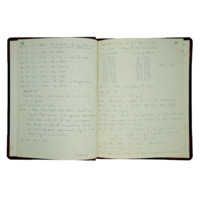 Notebooks
 These books contain two notes that are associated with astonishing observations and great joy for Douglas Osheroff. As a doctoral student, Osheroff was working on experiments where the isotope helium-3 was cooled to very low temperatures. On 29 November 1971 at 10:05 pm, he noted that the cooling rate suddenly at one point fell to one third. Osheroff and his supervisors David Lee and Robert Richardson realised that they were onto something important, but they weren't sure exactly what. On 20 April 1972, at 2:40 am, Osheroff jotted down a new observation. He had found the explanation for the phenomenon: helium-3 could become super fluid.
“It was an exciting moment. There was absolutely nobody else in the entire building to share my discovery with. So, I waited an hour, until I couldn’t stand it any longer, and then I called my advisers.”
The discovery earned Osheroff, Lee and Richardson the 1996 Nobel Prize in Physics.
Douglas Osheroff donated the notebooks to the Nobel Prize Museum in 2004.
-
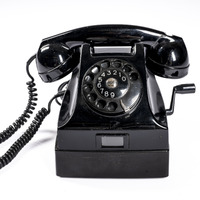 Telephone
 In the 20th century, the telephone became an increasingly important way to keep in touch with colleagues. This phone belonged to Gunnar Myrdal, who had a wide network as a researcher and politician. In 1933, he became professor of economics, and the following year a member of the Swedish parliament for the Social Democrats.
Myrdal also worked internationally. He spent the years before and after the Second World War in the U.S., writing such works as the highly-acclaimed An American Dilemma, a study of race relations and the conditions of the African American population. He also received assignments from the United Nations. Myrdal's analyses focused not just on economic factors. He also wove in historical, social, political, and other aspects. In the latter part of his life, he became committed to fighting the unequal distribution of global resources between rich and poor countries.
The telephone was donated to the Nobel Prize Museum by the Myrdal family in 2004.
-
 Cap
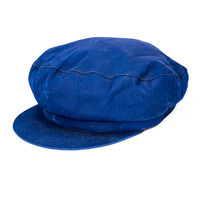
Cap This cap belonged to Herbert Simon. It is Chinese and was worn by Simon i China and the U.S.
The cap were donated to the Nobel Prize Museum by Herbert Simon’s family in 2003.
-
 Pocket calculator
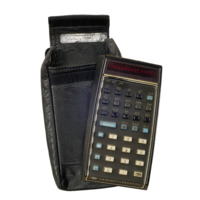
 A pocket calculator can be associated an analytical and deeply reasoning mind. Herbert Simon, who used this calculator for many years, had that, but was very versatile and also partly had a different view of man. In Simon's day, established economic theories were based on the notion that all businesses and entrepreneurs acted in a strictly rational manner, with their own profit maximization as their only goal. Simon believed that people's choices diverge from the strictly rational, and he described businesses as adaptable systems with physical, personal, and social elements. Adopting this viewpoint, he was able to describe modern society's decision-making processes from a completely different perspective.
The calculator was donated to the Nobel Prize Museum by Herbert Simon’s family in 2003.
-
 Portfolio with drawings
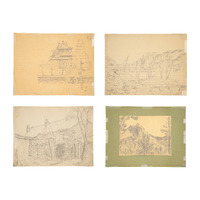
 These drawings were made by Herbert Simon, who had many interests apart from his economic research. He enjoyed travelling and hiking and often brought his sketch pad and charcoal along.
The drawings were donated the to the Nobel Prize Museum by Herbert Simon’s family in 2004.