-
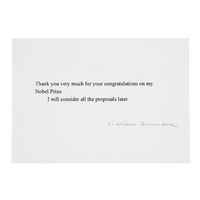 Thank you card
 Szymborska put a great deal of energy into demonstrating for everyone that the Nobel Prize had not gone to her head. She sent handwritten thank you cards to all of her old friends and acquaintances who congratulated her on the prize. But when she was overwhelmed by congratulations from unknown people, she decided to print official thank you cards, both in Polish and English, which she simply signed.
The thank you card was donated to the Nobel Prize Museum by the Wisława Szymborska Foundation in 2021.
-
 Eyeglasses
 Wisława Szymborska was only slightly myopic and didn’t always need glasses. After being awarded the Nobel Prize in literature in 1996, however, she often wore glasses when she went out, because fewer people recognised her in them, shielding her from fans.
The eyeglasses were donated to the Nobel Prize Museum by the Wisława Szymborska Foundation in 2021.
-
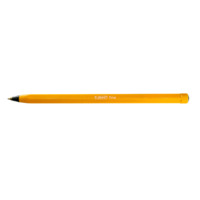 Ballpoint pen
 This ballpoint pen was an important tool in Wisława Szymborska’s literary output. She would write the first draft of a poem on a typewriter based on notes she had jotted down. Szymborska then made handwritten corrections on the typed manuscript with an ordinary plastic BIC ballpoint pen, always in black ink. These corrections could include added words and arrows. Sometimes, she cut up the sheets of paper with scissors and pasted the pieces back together in a new order. Only then was her secretary allowed to type out a fair copy of the poem on the computer to be presented to the world.
The pen was donated to the Nobel Prize Museum by the Wisława Szymborska Foundation in 2021.
-
 Behavioural chamber
 This box was used in experiments for measuring a mouse’s preference for different surface temperatures. David Julius's research has increased our understanding of how our nervous system senses heat and cold. Receptors on the cell surface play a key role in this process. The research was conducted on mice whose genes for different receptors had been deactivated. The chamber has two parts, the temperature of which can be varied. A mouse where a temperature-sensitive gene has been deactivated moves between the two parts, while an ordinary mouse prefers the part with a comfortable temperature.
David Julius donated the behavioural chamber to the Nobel Prize Museum in 2021.
-
 Dress
Dress This dress, which belonged to Nadia Murad, is associated with horrific events but also with hope.
In August 2014, the Islamic State (IS) launched a brutal attack on Nadia Murad’s village Kocho in northern Iraq. The younger women, including Murad, were abducted and held as sex slaves. After three months Nadia Murad managed to escape.
This is how she describes the dress:
“This dress represents many things to me. It reminds me of a time long ago, before the violence of genocide swept my community. In Kocho, my cousin was planning to get married. There was some fabric at home, and I worked with my nieces Nesrin and Kathrine to make a dress for me to wear at the wedding. I loved weddings and was very much looking forward to doing my makeup and hair. But the wedding never happened. ISIS came and destroyed my home and my community. They took my mother and brothers from me. I felt nothing but sadness and despair for a long time.
Years later, I travelled back to Kocho and visited the place where my house once stood. To my surprise, among the rubble of my old home, there was the wedding dress. It lay among the ruins relatively untouched. In that moment, I felt the untouched dress symbolised hope. Hope that I would again feel the joy I once felt being surrounded by my family and community. Hope that my community would one day be able to return to Sinjar and rebuild their lives.
It is this hope that I hold onto in times of darkness. It is this hope that drives me to keep moving forward and fighting for justice.”
Nadia Murad donated the dress to the Nobel Prize Museum in 2021.
-
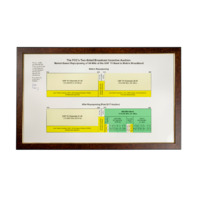 Public frequency chart
 This chart, created by the US Federal Communications Commission, is a graphic representation of how broadcast rights in different frequency bands are distributed between interested parties. Allocating broadcast rights in different frequency bands is a complex problem, since many variables must be taken into account. In 1994, spectrum auctions, where companies could bid for rights, were organised in the US. The auctions used a new format, Simultaneous Multi-Round Auction (SMRA), specifically designed for this purpose by Paul Milgrom and Robert Wilson.
Paul Milgrom donated the chart to the Nobel Prize Museum in 2021.
-
 Pocket calculator
 The auction formats developed by Robert B. Wilson required advanced calculations. In the 1980s, he used this Hewlett-Packard hand-held electronic calculator frequently when consulting with oil companies about bidding in auctions for rights to off-shore exploration of tracts. The calculator is unusual in that it uses "reverse Polish notation" for its programs. Though the battery may be weak, it still works and probably still has Wilson's programs for computing optimal bids and other aspects of strategy in its memory.
Robert B. Wilson donated the pocket calculator to the Nobel Prize Museum in 2021.
-
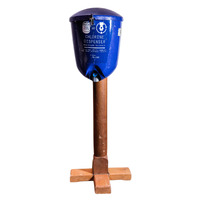 Chlorine dispenser
 Chlorine solution in the container purifies water from bacteria. The container was used in research projects in Kenya, where Michael Kremer and his students studied methods to combat poverty. One problem they investigated was diarrhoeal diseases, which are often caused by poor water quality. The method with free chlorine solution dispensers adjacent to the water sources proved effective.
Michael Kremer donated the chlorine dispenser to the Nobel Prize Museum in 2019.
-
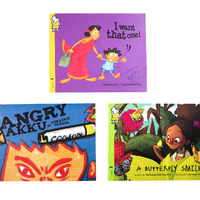 Children's books
 Pratham, an innovative learning organisation in India, produced these children’s books. Esther Duflo collaborated with the organisation when she first headed a field experiment on how to combat poverty. Among other things, Pratham helps teachers learn to teach at the right level, and the books are part of the programme called “Teaching at the right level”. The programme proved to be possible to apply at different levels and different scales worldwide.
Esther Duflo donated the books to the Nobel Prize Museum in 2019.
-
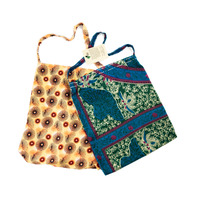 Cloth bags
 These bags were made by women in Ghana who were living in extreme poverty. The bags were part of one of Abhijit Banerjee's research projects, which studied ways of improving their economic situation. The participants were provided with support and means of producing textile bags as paid labour alongside their farm work, and their productivity was measured. 170,000 bags were made, and the conclusion was that support given to the extremely poor resulted in increased productivity, not passivity.
Abhijit Banerjee donated the bags to the Nobel Prize Museum in 2019.
-
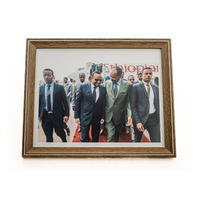 Photograph
 This photo shows Ethiopian President Abiy Ahmed Ali meeting Eritrean President Isaias Afwerki. Abiy Ahmed received the Nobel Peace Prize for his initiative to resolve the border conflict between Ethiopia and Eritrea.
Abiy Ahmed Ali donated the photograph to the Nobel Prize Museum in 2019.
-
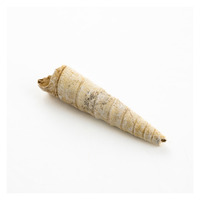 Fossil
 Peter Handke found this fossil on a beach on a walk with his wife. It is a prehistoric species of octopus – an orthoceras – which resembles octopuses of the Nautilus genus living today.
Peter Handke donated the mushroom prints and the fossil to the Nobel Prize Museum in 2019.
-
 Mushroom prints
 These mushroom prints are mementos of a couple of Peter Handke’s favourite walks. On his walks, Handke enjoys picking mushrooms that he presses between the pages of his notebooks. He made these “mushroom prints” on separate papers and signed them.
Peter Handke donated the mushroom prints to the Nobel Prize Museum in 2019.
-
 Calendar
 Olga Tokarczuk filled her personal calendar with notes on what she did day by day. In 2019 Tokarczuk was awarded the Nobel Prize in Literature, which had been postponed from 2018. This made her feel like she was in a time machine. Of course, her personal calendar from 2018 says nothing about the Nobel Prize, because she still did not know that she would be that year’s laureate.
Olga Tokarczuk donated the calendar to the Nobel Prize Museum in 2019.
-
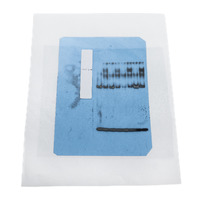 Electrophoresis image
 The image comes from an experiment using electrophoresis to identify the protein that determines how the body reacts to low oxygen levels. Gregg Semenza and his colleagues conducted the experiment. They succeeded in purifying a protein, which they named HIF-1. The results opened a new research field about oxygenation of the body.
Gregg Semenza donated the image to the Nobel Prize Museum in 2019.
-
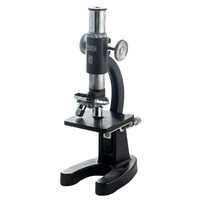 Children's microscope
 William Kaelin used this microscope as a child. When he became a scientist, he contributed to finding the explanations to the molecular mechanism governing the body's reactions to different oxygen levels.
William Kaelin donated the microscope to the Nobel Prize Museum in 2019.
-
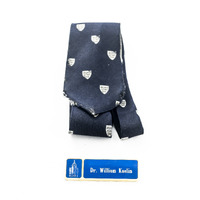 Tie and name plate
 During his internship as a physician at Johns Hopkins University, William Kaelin wore this tie every Friday, according to the tradition there. He also wore the name plate during this period.
William Kaelin donated the tie and the name plate to the Nobel Prize Museum in 2019.
-
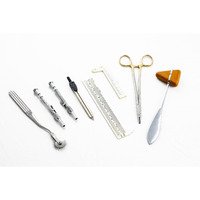 Doctor's instruments
 William Kaelin used these instruments during his internship as a physician at Johns Hopkins University. They include a hemostat, which is used to control bleeding during surgery, and a reflex hammer, which is used to test reflexes.
William Kaelin donated the instruments to the Nobel Prize Museum in 2019.
-
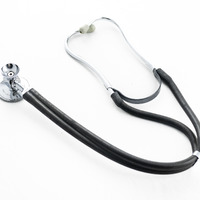 Stethoscope
 This stethoscope was used for listening to heart and lungs by William Kaelin during his internship as a physician at Johns Hopkins University.
William Kaelin donated the stethscope to the Nobel Prize Museum in 2019.
-
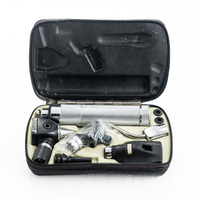 Otoscope
 This otoscope was used for examining the ears by William Kaelin during his internship as a physician at Johns Hopkins University.
William Kaelin donated the otoscope to the Nobel Prize Museum in 2019.
-
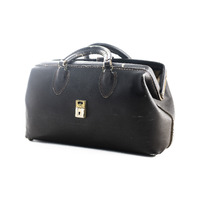 Doctor's bag
 William Kaelin had this doctor’s bag during his internship as a physician at Johns Hopkins University. Kaelin no longer practises medicine but devotes himself entirely to research. He has helped explain the molecular mechanism governing the body’s reactions to different oxygen levels.
William Kaelin donated the doctor’s bag to the Nobel Prize Museum in 2019.
-
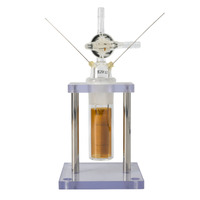 Test cell for battery (replica)
 This is a replica of a test cell for the first lithium-ion battery dating back to 1983. The test cell was developed by Akira Yoshino, who played a crucial part in developing lithium-ion batteries.
Akira Yoshino donated the test cell to the Nobel Prize Museum in 2019.
-
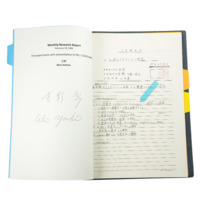 Monthly report, replica
 I en handskriven månadsrapport från februari 1983 beskrev Akira Yoshino för första gången ett experiment med en ny elektrod han utvecklat för litiumjonbatterier. Detta är en kopia av rapporten.
Akira Yoshino donerade kopian av rapporten till Nobelprismuseet 2019.
-
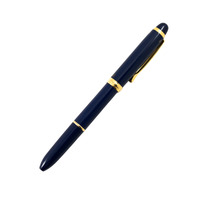 Pen
Pen This pen was Akira Yoshino’s favourite pen, which he used for 10 years.
Akira Yoshino donated the pen to the Nobel Prize Museum in 2019.
-
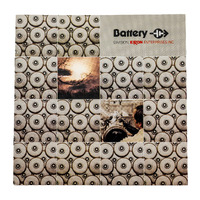 Brochure
 This brochure, printed in 1978, introduced and marketed a new type of rechargeable batteries, which were produced at the battery unit of the oil and gas company Exxon. Stanley Whittingham made pivotal contributions to the development of the batteries.
Stanley Whittingham donated the brochure to the Nobel Prize Museum in 2019.
-
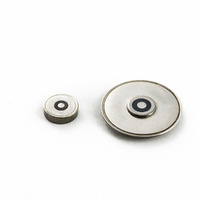 Two batteries
 These two batteries are early versions of lithium batteries from the 1970s. They were produced at the battery unit of Exxon, the oil and gas company where Stanley Whittingham made pivotal contributions to the development of the batteries. The smaller battery was intended for a watch and the larger one for a solar cell.
Stanley Whittingham donated the lithium batteries to the Nobel Prize Museum in 2019.
-
 Witness to Grace by John B. Goodenough
 This book Witness to Grace is John B. Goodenough’s autobiography. In the book he recounts his upbringing and intellectual development, his Christian faith and how he came to devote himself to science and technology.
John B. Goodenough donated the book to the Nobel Prize Museum in 2019.
-
 Key
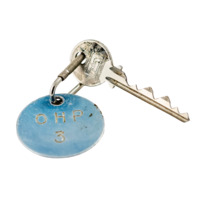
Key This key, labelled “OHP,” goes to the Haute-Provence observatory in southern France. It was given to Didier Queloz during his time as a doctoral student by his supervisor, Michel Mayor, who was about to leave on an extended trip. Soon afterwards, Queloz made an interesting observation of a star’s movements. After additional observations of the star, Queloz and Mayor concluded that they had made the first discovery of a planet orbiting a star other than our sun.
Didier Queloz donated the key to the Nobel Prize Museum in 2019.
-
 Glass with template
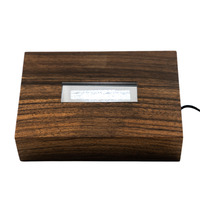
 This glass was an important part of the equipment Michel Mayor used to search for exoplanets – planets in solar systems other than ours. Stars with planets display a slightly rocking motion. As a result of the Doppler effect, the movement causes the color of the star to change – its spectrum shifts. To study this, a spectrograph coupled with a telescope was used. The glass, which belonged to the spectrograph, served as a template to effectively compare many spectral lines at the same time. If the entire spectrum shifts, the light passing through increases or decreases, depending on the amount of incident light covered by the dark spots on the glass. This glass was the first used when Mayor began investigations in 1977 that would eventually lead to the discovery of exoplanets.
Michel Mayor donated the glass template to the Nobel Prize Museum in 2019.
-
 Slide rule
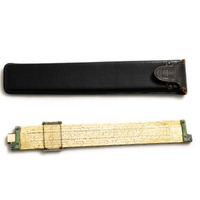
 James Peebles bought this slide rule in 1953 when he was studying at the University of Manitoba. It cost 20 Canadian dollars, a rather hefty sum for a student. It became his constant companion in life as a physicist until 1970, when he bought an electronic calculator. He put the slide rule in a desk drawer, where it lay for years, acquiring a patina.
James Peebles donated the slide rule to the Nobel Prize Museum in 2019.
-
 Slide rule
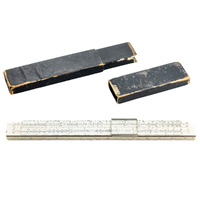
 Werner Arber bought this slide rule when he was a high-school student in Aarau, Switzerland. He used it for several decades for his studies and research, before replacing it with electronic devices. Arber's Nobel Prize-winning work is about restriction enzymes, which are used for DNA analysis and modification.
Werner Arber donated the slide rule to the Nobel Prize Museum in 2019.
-
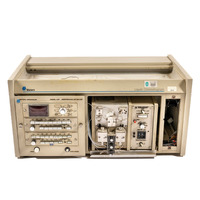 HPLC apparatus
 This HPLC (High Performance Liquid Chromatography) apparatus was used by Robert Lefkowitz and colleagues in the early 1980s, as one of the steps to purify the beta adrenergic receptor, the first G protein coupled receptor to be purified. Drugs targeting G protein coupled receptors account for a substantial part of all drugs used in clinical medicine.
In chemistry, chromatography is an important method for separating substances. A mixture of substances dissolved in a liquid or gas is allowed to migrate through a stationary phase, for example a granular material consisting of solid particles. Because the components in the mixture interact with the grains in different ways, they will move at different speeds. In this way, the components are separated.
Robert Lefkowitz donated the HPLC apparatus to the Nobel Prize Museum in 2019.
-
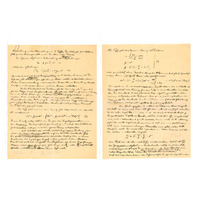 Manuscript
 This manuscript was written in 1922, when Albert Einstein had just heard that he had been awarded the 1921 Nobel Prize in Physics. Many physicists were still skeptical of his theory of general relativity, which turned the conceptions of time, space and gravity of classical physics upside down. Einstein did not receive the prize for his theory of relativity but for other ground-breaking work. However, many physicists and mathematicians continued to work according to the theory of relativity. One of the them was Eric Trefftz, who thought he had found a solution to a problem in the theory of general relativity – how two bodies move around a common center of mass. In the manuscript, Einstein comments on Trefftz’s article and demonstrates problems with his solution.
One of the previous owners of the manuscript was Max von Laue, who was awarded the Nobel Prize in Physics in 1914. This manuscript was donated to the Nobel Prize Museum by Åsa and Per Taube.
-
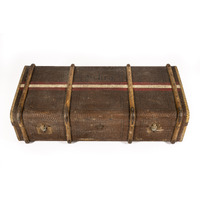 Trunk
Trunk This trunk belonged to Erwin Schrödinger, a pioneer of quantum physics. Schrödinger lived an itinerant life. He grew up and studied in Vienna, Austria and later worked at several European universities. When Nazi Germany annexed Austria in 1938, he was working at the University of Graz. Schrödinger, who strongly opposed Nazism, fled to Italy and eventually to Ireland. However, he left this trunk behind in Graz, where it was kept by Schrödinger's friend and colleague Fritz Kohlrausch. The Kohlrausch family stored it in their attic until 2019, when they donated it to the Nobel Prize Museum.
-
 Tres Poemas by Gabriela Mistral
 The book Tres Poemas contains poems by Gabriela Mistral that have been set to music in arrangements for voice and piano by the Chilean composer Jorge Urrutia Blondel. The book was signed by Mistral, with a dedication to Manuel Sayago.
The book was donated to the Nobel Prize Museum by Heraldo Muñoz, Chile’s former minister of foreign affairs, in 2019.
-
 Poèmes choisis av Gabriela Mistral
 Boken Poèmes choisis innehåller dikter av Gabriela Mistral i fransk översättning. Boken är signerad av Mistral och dedicerad till den chilenske författaren och arkitekten Pedro Prado 1946. Detta exemplar är nummer 5 av 200 numrerade exemplar i denna upplaga.
Boken donerades till Nobelprismuseet av Chiles tidigare utrikesminister Heraldo Muñoz 2019.
-
 Giotto by Carlo Carrá
 Boken Giotto av Carlo Carrà kommer från Gabriela Mistrals personliga bibliotek. Hennes samling av böcker avspeglar hennes intresse för en rad områden, bland annat biografier, zoologi, geografi och religion. Denna bok om den medeltida konstnären Giotto di Bondone är på italienska och skriven 1924 av konstnären Carlo Carrà, som under början av 1910-talet var en av futurismens ledande företrädare.
Boken överlämnades till Nobelprismuseet 2019 av Pedro Pablo Zegers, chef för Chiles nationalbibliotek, och Hernán Bascuñán, Chiles ambassadör.
-
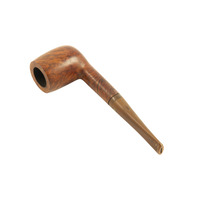 Pipe
Pipe For Pablo Neruda, this pipe was associated with an effort he made at the end of the 1930s alongside his literary work. After the Spanish Civil War, thousands of refugees were living in camps in France under harsh conditions. Pablo Neruda was appointed by the president of Chile, Pedro Aguirre Cerda, to help them get to Chile. On 3 September 1939, the steamer Winnipeg arrived at Valparaiso, Chile. Neruda used to smoke this pipe in those days. He called his achievement his “greatest poem” and preserved the pipe with great care as a memory.
The pipe was donated to the Nobel Prize Museum by the Pablo Neruda Foundation in 2019.
-
 Recorders
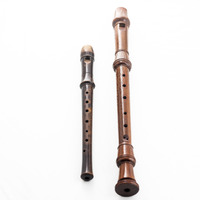
 Since childhood, Richard Ernst has been deeply interested in music. His first musical instrument was a soprano recorder. He later acquired an alto recorder because a wider range of notes appealed to him.
Richard Ernst donated the recorders to the Nobel Prize Museum in 2019.
-
 Gas mantle
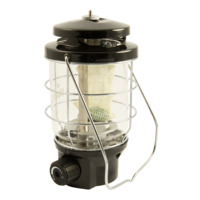
 Paul Romer regards this gas mantle as a fine example of the historical importance of technological innovation. Romer’s research focuses on how knowledge and new ideas drive economic growth. This type of lamp is based on the principle of Auer’s incandescent light. An incandescent mantle emits light because of the heat given off by burning gas. The lamp was a far more efficient light source than oil lamps and the earlier gas lights. After the lamp was invented in the 1880s, it soon became common as street lighting. Nowadays, lamps like these are used by campers.
Paul Romer donated the gas mantle to the Nobel Prize Museum in 2018.
-
 Oil lamp
 William Nordhaus acquired this Roman oil lamp in conjunction with an economic-historical study on lighting. The lamp is about 2,500 years old. In his work, Nordhaus examined the cost of achieving a certain amount of light at different times in human history. He investigated methods of producing light, from open fires all the way to incandescent light. He was struck by how much more efficient they have become.
William Nordhaus donated the oil lamp to the Nobel Prize Museum in 2018.
-
 Calligraphy
 In this calligraphy, Tasuku Honjo has written a motto that has been important to him throughout his life: “Without ambition, success cannot be achieved.” The motto is written in Chinese characters and comes from Chinese Emperor Guangwu of Han, who lived from 6 BCE to 57 CE. When Honjo did his groundbreaking work on how the immune system can be used to fight cancer, what he encountered was not direct resistance but indifference and scepticism. But he kept going and ultimately reached his goal.
Tasuku Honjo donated the calligraphy to the Nobel Prize Museum in 2018.
-
 Photograph
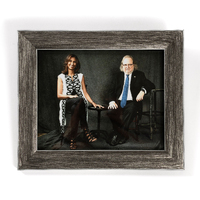
 This photograph shows James Allison and his wife and colleague Padmanee Sharma.
James Allison donated the photograph to the Nobel Prize Museum in 2018.
-
 Specification for apparatus and photograph
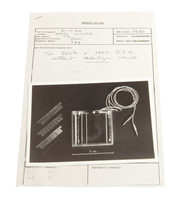
 This apparatus specification tells of an early stage in Gregory P. Winter's research.
In the late 1970s Winter went to Poland for a conference to raise awareness of new methods for mapping genes, DNA sequencing. At the conference, Soviet researchers told him how they prepared agarose gel, a gelatinous substance used in the sequencing. Inspired by what he learned, Winter developed a simple apparatus back home in Cambridge. However, those responsible for safety in the laboratory considered the apparatus dangerous and drew up specifications for a safer one. The photo shows an apparatus that no longer exists.
Gregory P. Winter donated the specification and the photograph to the Nobel Prize Museum in 2018.
-
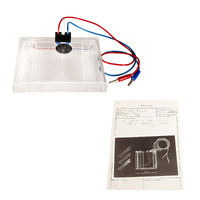 Reconstruction, specification and photo of an apparatus for DNA sequencing
 This apparatus is a reconstruction of an apparatus for DNA sequencing. In the late 1970s Gregory P. Winter went to Poland for a conference to raise awareness of new methods for mapping genes, DNA sequencing. At the conference, Soviet researchers told him how they prepared agarose gel, a gelatinous substance used in the sequencing. Inspired by what he learned, Winter developed a simple apparatus back home in Cambridge. However, those responsible for safety in the laboratory considered the apparatus dangerous and drew up specifications for a safer one. The photo shows an apparatus that no longer exists.
-
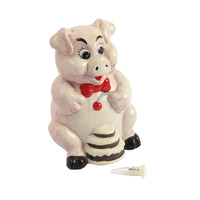 Piggy bank
 George Smith gave this piggy bank to one of his colleagues, Stephen Parmley, as a memento of an early experiment when working on phage display. Parmley had developed a vector, a particle used to inject DNA in living cells. The vector was named pIG3C. The experiment was unsuccessful, but the piggy bank became the laboratory mascot for decades.
The piggy bank was donated to the Nobel Prize Museum by Stephen Parmley in 2018.
-
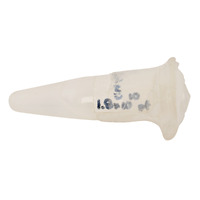 Vial with solution
 This test tube contains the solution in which George P. Smith first applied the phage display method. The phage display method, which Smith developed, uses bacteriophages, viruses that attack bacteria, to produce new proteins. Smith received the test solution from Paul Modrich (who, incidentally, was awarded the Nobel Prize in Chemistry in 2015).
George P. Smith donated the test tube to the Nobel Prize Museum in 2018.
-
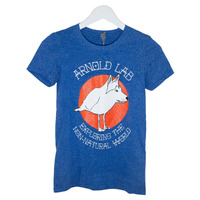 T-shirt
 A T-shirt from Frances Arnold’s laboratory bears the image of the laboratory’s Wolfird mascot, a combination of a wolf and a bird. Arnold uses the mascot to convey the message that when you culture molecules in test tubes, you can mix anything.
This particular light blue shirt was worn by Arnold during a trip with all of her lab colleagues. The names of all members of the team are on the back of the t-shirt.
Frances Arnold donated the T-shirt to the Nobel Prize Museum in 2018.
-
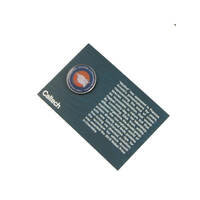 Button
 A button from Frances Arnold’s laboratory bears the image of the laboratory’s Wolfird mascot, a combination of a wolf and a bird. Arnold uses the mascot to convey the message that when you culture molecules in test tubes, you can mix anything.
Frances Arnold donated the button to the Nobel Prize Museum in 2018.
-
 T-shirt
 A T-shirt from Arnold’s laboratory bears the image of the laboratory’s Wolfird mascot, a combination of a wolf and a bird. Arnold uses the mascot to convey the message that when you culture molecules in test tubes, you can mix anything.
Frances Arnold donated the T-shirt to the Nobel Prize Museum in 2018.