-
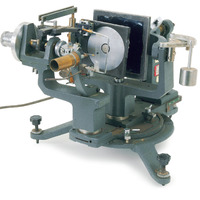 X-ray crystallography camera
 The X-ray camera was used by Max Perutz and John Kendrew in their research on the structure of the proteins hemoglobin and myoglobin.
The camera was invented by mineralogist M. J. Buerger in the early 1940s. On its X-ray diffraction photographs the spots are arranged at the corners of a three¬dimensional lattice which is the reciprocal of the real lattice. These photographs were more straightforward to interpret than the ones taken with other types of camera used before.
The precession camera moves the crystal about one of its axes like a spinning top. Max Perutz and John Kendrew used it together with a home-built X-ray tube with a rotating anode that gave a beam ten times more intense than any commercial tube. Thanks to these instruments they were better equipped for protein crystallography than any other laboratory in the world; this contributed decisively to their solution of the first protein structures.
The camera was presented to the Nobel Prize Museum in 2000 by Max Perutz.
-
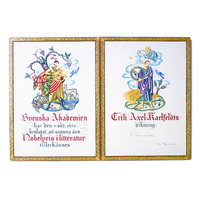 Erik Axel Karlfeldt's Nobel Prize diploma
 The 1931 Nobel Prize in Literature was awarded for the poetry of Erik Axel Karlfeldt. Karlfeldt, who had been the permanent secretary of the Swedish Academy, had died a few months before the prize was awarded. Since 1974, Nobel Prizes cannot be awarded posthumously.
The Nobel Prize diploma was created by the artist Berta Svensson-Piehl, who in a letter to Karlfeldt's widow Gerda Karlfeldt in 1945 described the diploma as follows :
“First page: Erik Axel Karlfeldt’s poetry was like a deeply-rooted, fruit-bearing tree, with a fresh spring at its foot.
The figure is a symbol of the art of poetry, a Fridolin with his golden lyre.
At his feet lies a cornucopia with Flora and Pomona. The deer a symbol of the listening audience.
Page 2: The laurel wreath symbolises the Nobel Prize, the golden corn sheaf bowing down to the earth and the figure pointing upwards to the clouds signify that the prize was awarded after the poet’s death.”
The diploma was donated to the Nobel Prize Museum by Erik Axel Karlfeldt's family in 2000.
-
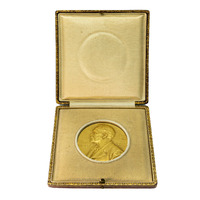 Erik Axel Karlfeldt's Nobel Prize medal
 The 1931 Nobel Prize in Literature was awarded for the poetry of Erik Axel Karlfeldt. Karlfeldt, who had been the permanent secretary of the Swedish Academy, had died a few months before the prize was awarded. Still, a Nobel Prize medal was made. Since 1974, Nobel Prizes cannot be awarded posthumously.
The medal was donated to the Nobel Prize Museum by Erik Axel Karlfeldt's family in 2000.
-
Center for Civil Liberties
https://nobelprize.museum.link/s/multilingual-en/item/18678
-
Memorial
https://nobelprize.museum.link/s/multilingual-en/item/18678
-
World Food Programme
https://nobelprize.museum.link/s/multilingual-en/item/18676
-
International Campaign to Abolish Nuclear Weapons
https://nobelprize.museum.link/s/multilingual-en/item/18673
-
National Dialogue Quartet
https://nobelprize.museum.link/s/multilingual-en/item/18671
-
Organisation for the Prohibition of Chemical Weapons
https://nobelprize.museum.link/s/multilingual-en/item/18669
-
European Union
https://nobelprize.museum.link/s/multilingual-en/item/18668
-
Intergovernmental Panel on Climate Change
https://nobelprize.museum.link/s/multilingual-en/item/18663
-
Grameen Bank
https://nobelprize.museum.link/s/multilingual-en/item/18662
-
International Atomic Energy Agency
https://nobelprize.museum.link/s/multilingual-en/item/18661
-
United Nations
https://nobelprize.museum.link/s/multilingual-en/item/18657
-
Doctors Without Borders
https://nobelprize.museum.link/s/multilingual-en/item/18655
-
International Campaign to Ban Landmines
https://nobelprize.museum.link/s/multilingual-en/item/18653
-
Pugwash Conferences on Science and World Affairs
https://nobelprize.museum.link/s/multilingual-en/item/18651
-
United Nations Peacekeeping Forces
https://nobelprize.museum.link/s/multilingual-en/item/18644
-
International Physicians for the Prevention of Nuclear War
https://nobelprize.museum.link/s/multilingual-en/item/18641
-
Amnesty International
https://nobelprize.museum.link/s/multilingual-en/item/18633
-
International Labour Organization
https://nobelprize.museum.link/s/multilingual-en/item/18626
-
United Nations Children's Fund
https://nobelprize.museum.link/s/multilingual-en/item/18624
-
League of Red Cross Societies
https://nobelprize.museum.link/s/multilingual-en/item/18622
-
Office of the United Nations High Commissioner for Refugees (UNHCR)
https://nobelprize.museum.link/s/multilingual-en/item/18637
-
American Friends Service Committee
https://nobelprize.museum.link/s/multilingual-en/item/18541
-
Friends Service Council
https://nobelprize.museum.link/s/multilingual-en/item/18541
-
Nansen International Office for Refugees
https://nobelprize.museum.link/s/multilingual-en/item/18537
-
International Committee of the Red Cross
https://nobelprize.museum.link/s/multilingual-en/item/18622
-
Permanent International Peace Bureau
https://nobelprize.museum.link/s/multilingual-en/item/18611
-
Institute of International Law
https://nobelprize.museum.link/s/multilingual-en/item/18605
-
Claudia Goldin
https://nobelprize.museum.link/s/multilingual-en/item/18601
-
Narges Mohammadi
https://nobelprize.museum.link/s/multilingual-en/item/18679
-
Jon Fosse
https://nobelprize.museum.link/s/multilingual-en/item/19027
-
Aleksey Yekimov
https://nobelprize.museum.link/s/multilingual-en/item/18911
-
Louis Brus
https://nobelprize.museum.link/s/multilingual-en/item/18911
-
Moungi Bawendi
https://nobelprize.museum.link/s/multilingual-en/item/18911
-
Anne L’Huillier
https://nobelprize.museum.link/s/multilingual-en/item/18796
-
Ferenc Krausz
https://nobelprize.museum.link/s/multilingual-en/item/18796
-
Pierre Agostini
https://nobelprize.museum.link/s/multilingual-en/item/18796
-
Drew Weissman
https://nobelprize.museum.link/s/multilingual-en/item/19141
-
Katalin Karikó
https://nobelprize.museum.link/s/multilingual-en/item/19141
-
Philip Dybvig
https://nobelprize.museum.link/s/multilingual-en/item/18600
-
Douglas Diamond
https://nobelprize.museum.link/s/multilingual-en/item/18600
-
Ben Bernanke
https://nobelprize.museum.link/s/multilingual-en/item/18600
-
Ales Bialiatski
https://nobelprize.museum.link/s/multilingual-en/item/18678
-
Annie Ernaux
https://nobelprize.museum.link/s/multilingual-en/item/19026
-
Morten Meldal
https://nobelprize.museum.link/s/multilingual-en/item/18910
-
Carolyn Bertozzi
https://nobelprize.museum.link/s/multilingual-en/item/18910
-
Anton Zeilinger
https://nobelprize.museum.link/s/multilingual-en/item/18795
-
John Clauser
https://nobelprize.museum.link/s/multilingual-en/item/18795