-
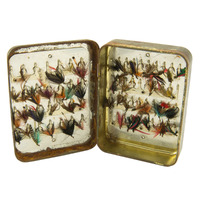 Fishing flies
 Even in his youth, Angus Deaton eagerly went on fishing trips for some time alone. These fishing trips taught him that he is often at his most creative when doing something other than his regular routine. While fishing, he could unconsciously explore scientific problems – an experience he shares with many. This box of flies is from the mid-1950s. The flies are all different and have specific names. Deaton has tied some of them himself but says his talent lies more in economics.
Angus Deaton donated the fishing flies to the Nobel Prize Museum in 2015.
-
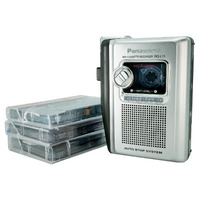 Dictaphone
 Dictaphones have been important to Svetlana Alexievich's literary process. Her documentary novels are based on large numbers of interviews. This dictaphone was used when collecting material for the books Zinky Boys and Voices from Chernobyl. The tapes contain some of the many interviews.
In her Nobel Prize lecture Alexievich said,
“It always troubled me that the truth doesn’t fit into one heart, into one mind, that truth is somehow splintered. There’s a lot of it, it is varied, and it is strewn about the world. Dostoevsky thought that humanity knows much, much more about itself than it has recorded in literature. So, what is it that I do? I collect the everyday life of feelings, thoughts, and words. I collect the life of my time.”
Svetlana Alexievich donated the dictaphone and the tapes to the Nobel Prize Museum in 2015.
-
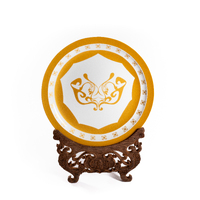 Plate
Plate The plate was designed by fashion designer Galo in connection with Tu Youyou receiving the Nobel Prize in Physiology or Medicine in 2015. Galo also designed the clothes Tu Youyou wore during Nobel Week.
Tu Youyou donated the plate to the Nobel Prize Museum in 2015.
-
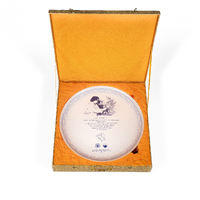 Plate
Plate This plate commemorates Tu Youyou's discovery of the antimalarial drug artemisinin.
Tu Youyou donated the plate to the Nobel Prize Museum in 2015.
-
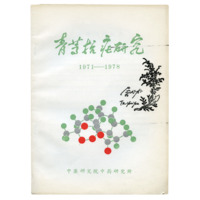 Research report
 This book is the first publication describing the results of a project on antimalarial drugs. Tu Youyou played a crucial role in the project.
Malaria is a widespread disease in tropical countries. It is caused by a parasite that spreads through mosquitoes and is often treated with quinine. During the Vietnam War, North Vietnamese soldiers suffered from a form of malaria in which the parasite was resistant to quinine. After North Vietnam asked China for help in developing a new treatment for malaria, China initiated a project where Tu Youyou participated. Drawing inspiration from ancient Chinese herbal recipes, she was able to extract a substance, artemisinin, from sweet wormwood extract. Artemisinin inhibits the malaria parasite.
Tu Youyou donated the research report to the Nobel Prize Museum in 2015.
-
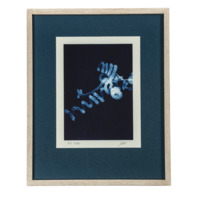 Collotype photograph
 This picture is a collotype photograph and is an image of the bacterium Streptomyces avermectinius. The image, originally taken with a scanning electron microscope, highlights the captivating beauty that Satoshi Ōmura sees in bacteria.
Satoshi Ōmura donated the collotype photograph to the Nobel Prize Museum in 2015.
-
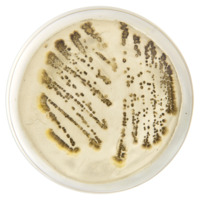 Petri dish with bacterial culture
 This dish contains the bacteria Streptomyces avermectinius, cultivated by Satoshi Ōmura, who often cultivated bacteria from soil, which can produce substances that inhibit other microorganisms. This can be useful when developing pharmaceuticals. Ōmura’s bacterial strain led to the drug avermectin, used to fight the diseases elephantiasis and river blindness.
Satoshi Ōmura donated the bacterial culture to the Nobel Prize Museum in 2015.
-
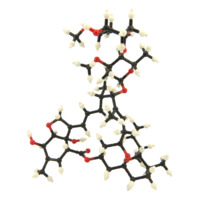 Molecular model of Ivermectin B1a
 This model shows the structure of the ivermectin B1a molecule. The substance could be extracted from a bacterial strain cultured by Satoshi Ōmura. This led to the drugs used to fight the diseases elephantiasis and river blindness.
Satoshi Ōmura donated the model to the Nobel Prize Museum in 2015.
-
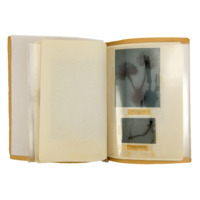 X-ray photographs
 When Paul Modrich was 15 years old, he convinced his father to order samples of radioactive isotopes of different substances. At that time, small amounts of radioactive isotopes could be purchased without a license. Modrich made solutions of isotopes in which he then put seeds to germinate and leaves that absorbed the isotopes. He also injected isotopes into frogs. He could then use X-ray photographs to see how the substances were distributed in the sprouts, the leaves and the frogs.
Paul Modrich donated the photographs to the Nobel Prize Museum in 2015.
-
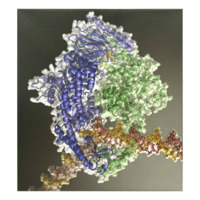 Picture
 The picture shows the structure of the protein MutS alpha, which was discovered by Paul Modrich in 1996. The protein is vital in detecting when errors have occurred in the replication of DNA molecules in our cells. A few years after Modrich's discovery, Lorena Beese determined the structure of the protein. It hung in Paul Modrich’s laboratory until he donated it to the Nobel Prize Museum.
Paul Modrich donated the image to the Nobel Prize Museum in 2015.
-
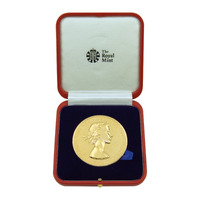 Medal
Medal The Royal Medal is one of the top scientific awards in the United Kingdom, and was an important recognition for Tomas Lindahl's scientific achievements. Awarded annually, the medals are given for the most outstanding scientific efforts made in the British Commonwealth. Tomas Lindahl is from Sweden, but has conducted his most important scientific work in the UK and received the medal in 2007. The medal is awarded by Queen Elizabeth II on the recommendation from the Royal Society, the independent scientific academy of the UK and the Commonwealth.
Tomas Lindahl donated the medal to the Nobel Prize Museum in 2015.
-
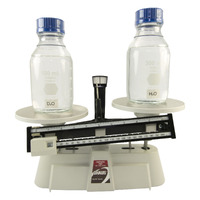 Heavy water
 Arthur McDonald has let heavy water represent his research at the Sudbury Neutrino Observatory (SNO). The bottles on the scales contain equal volumes of heavy and regular water respectively. As the scales show, the density of heavy water is about ten per cent higher.
(SNO) was an underground facility where physicists from Canada, the US and the UK studied neutrinos, some of the universe's smallest and most elusive particles. Almost all neutrinos zip unimpeded through the earth, but some of could be captured in the SNO detector. The detector used heavy water, where the nucleus of the hydrogen atoms has both a proton and a neutron. Heavy water allows the neutrinos to react differently than with regular water.
Arthur McDonald donated the heavy water to the Nobel Prize Museum in 2015.
-
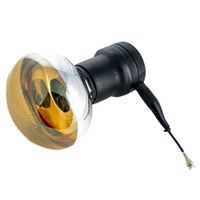 Small photomultiplier
 This photomultiplier tube representa Takaaki Kajita's research at the Super-Kamiokande underground facility in Japan. The facility is a collaboration between several nations. This photomultiplier tube belongs to a part managed by the US.
Takaaki Kajita donated the photomultiplier tubes to the Nobel Prize Museum in 2015.
-
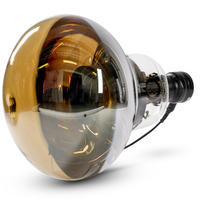 Large photomultiplier
 This photomultiplier tube represents Takaaki Kajita's research at the Super-Kamiokande underground facility in Japan. At the Super-Kamiokande, physicists study neutrinos, some of the smallest particles in the universe. The detector consists of a large water-filled container with walls lined with photomultiplier tubes. Neutrinos exist in large quantities but very rarely react with other particles. When they hit a particle in the Super-Kamiokande, this generates a small flash that can be detected and amplified by the photomultiplier tubes.
Takaaki Kajita donated the photomultiplier tube to the Nobel Prize Museum in 2015.
-
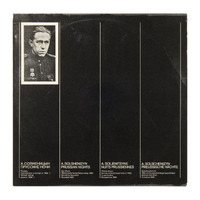 LP record
 Aleksandr Solzhenitsyn gave this LP record of him reading his epic poem Prussian Nights to Swedish journalist Stig Fredriksson, who hade become his friend. Because of his criticism of the Soviet social system, Aleksandr Solzhenitsyn's books were banned in the Soviet Union. Fredriksson smuggled out several of Solzhenitsyn’s manuscripts, including his Nobel Prize lecture. After Solzhenitsyn was exiled from the Soviet Union in 1974, Solzhenitsyn and Fredriksson met in Zurich. That was when the author gave Fredriksson this LP. It had been recorded secretly in the Soviet Union in 1969 and was released in the West.
The LP was donated to the Nobel Prize Museum by Stig Fredriksson in 2015.
-
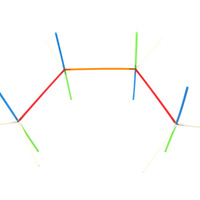 Model of a butadiene molecule
 This model depicts the molecule butadiene, which consists of four carbon atoms and six hydrogen atoms. This molecule was crucial to Roald Hoffmann's work on the role of electron orbits for chemical reactions. In 1964, Hoffmann’s mentor Robert Woodward told him about the novelty of butadiene’s chemical characteristics. He suspected that this was due to how the electron at the outer edge of the molecule moves in an orbit. Hoffmann expanded on this explanation. This plastic model is flexible, and he was able to use it to illustrate how the molecule could change its shape.
Roald Hoffmann donated the model to the Nobel Prize Museum in 2015.
-
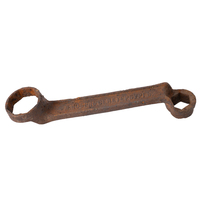 Spanner
 Blocknyckeln kommer från Ludvig Nobels mekaniska verkstad Sankt Petersburg. Den ryska märkningen på nyckeln betyder "L Nobel St Petersburg Nyckel".
Blocknyckeln anskaffades av Nobelprismuseet 2015.
-
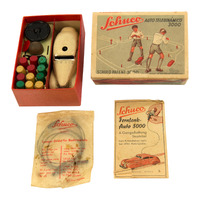 Toy car
 For Eric Kandel, this toy car is associated with memories from his childhood in Vienna in the 1930s.
When Kandel turned nine, he received a remote-controlled model car that had wished for. Two days later, on 9 November 1938, the November pogroms took place, when the Nazis persecuted Jews in Germany and Austria. The Kandel family was forced to leave their home, which was then looted. The toy car was lost, but Kandel never forgot it.
Later in life, Kandel devoted himself to research on the physiological foundations of memory: how memories are preserved in brain cells. In this context, he has told people about his memory of the toy car and received similar cars as gifts. This is one of those gifts.
Eric Kandel donated the toy car to the Nobel Prize Museum in 2015.
-
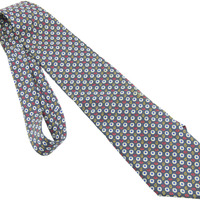 Tie
Tie Paul Crutzen was wearing this tie on a memorable occasion, namely when he told his colleagues at the Max Planck Institute for Chemistry in Mainz that he had been awarded the Nobel Prize.
Crutzen was born in the Netherlands but has worked in many different countries. His research on the chemistry of the atmosphere began in Sweden. When he received the Nobel Prize in Chemistry in 1995, he was working in Germany.
Paul Crutzen donated the tie to the Nobel Prize Museum in 2015.
-
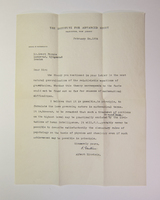 Letter from Albert Einstein to Evert Fornäs
 In a 1954 letter Albert Einstein replies to Evert Fornäs, a teacher at a Swedish folk high school, who had written Einstein about his general theory of relativity and the limitations of science based on mathematics. Einstein believes that in principle the laws of nature can be described in mathematical terms, but that the limitations of human intelligence makes it impossible to describe even elementary rules of psychology on the basis of physics and chemistry.
This letter was donated to the Nobel Prize Museum by the Fornäs family.
-
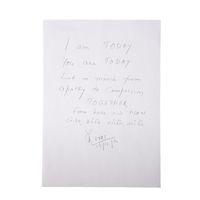 Greeting
 When Kailash Satyarthi visited the Nobel Prize Museum in December 2014 and donated a costume, he also handed over a sheet of paper with a message:
I am TODAY
You are TODAY
Let us march from
apathy to compassion TOGETHER.
From here and NOW.
-
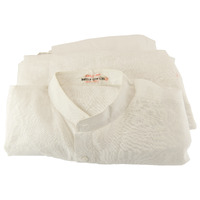 Khadi
Khadi Kailash Satyarthi wore this garment to receive the Nobel Peace Prize in Oslo in 2014. It is a khadi kurta, a traditional shirt of hand-spun and hand-woven cotton fabric. Khadi was also the name of a movement that the Indian leader Mahatma Gandhi began in the 1920s and which campaigned for domestically-produced goods and reduced imports. When Kailash Satyarthi visited the Nobel Prize Museum in Stockholm a few days after the Nobel Peace Prize award ceremony in Oslo, he donated his khadi to the museum.
-
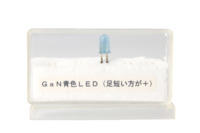 Light emitting diode (LED)
 This diode is an early version of the blue-light-emitting diode (LED) developed by Isamu Akasaki in 1978. It is a MIS (metal-insulator-semiconductor) LED and was the brightest until then. In the 1980s, working with Hiroshi Amano, Akasaki did further research on gallium nitride crystals, which eventually led to blue diodes that could be combined with red and green ones to make white light.
Isamu Akasaki donated the LED to the Nobel Prize Museum in 2014.
-
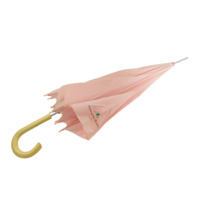 Umbrella
 For Mario Molina, this umbrella symbolised both his old school and the fragile ozone layer, to which he devoted his research.
When Molina was 11 years old, his parents sent him to the Institut auf dem Rosenberg boarding school in St. Gallen, Switzerland. It was there he developed his interest in chemistry and mathematics. Many years later, Molina was awarded the Nobel Prize in Chemistry for his research on the atmosphere’s ozone layer. His Nobel Prize diploma bears the image of an umbrella; a symbol for the way the ozone layer protects us from harmful ultraviolet radiation. When Molina later visited his old boarding school, this umbrella was presented to him as a gift.
Mario Molina donated the umbrella to the Nobel Prize Museum in 2014.
-
 Dress
Dress For women Nobel Prize laureates, the choice of attire for the Nobel Prize banquet is more complicated than for men. Men wear tailcoats, while women wear long evening dresses that can be in a variety of colours and designs. Elizabeth Blackburn, a 2009 laureate in medicine, had only a black dress and wanted to wear another colour to the banquet. The day before she went to the Nobel Week in Stockholm, she found this dress in a small shop in Paris. She wore her black dress to the award ceremony and changed into this red dress for the banquet.
The dress was donated to the Nobel Prize Museum by Elizabeth Blackburn in 2009.
-
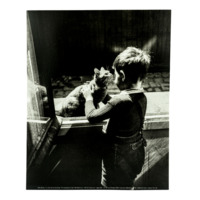 Photograph
 Patrick Modiano often draws the inspiration for his books from interviews, old newspaper cuttings, and his own notes. For many years, he also had this photograph on his desk, which gave him inspiration for his writing. It was taken by photographer Willy Ronis and is entitled The Caretaker’s Cat.
Patrick Modiano donated the photograph to the Nobel Prize Museum in 2014.
-
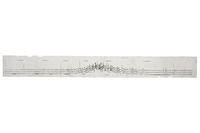 Paper with measurement data
 For William E. Moerner, a paper with measurement data mark an important step in the development of microscopes capable of showing levels of detail that had previously been impossible.
When an electron shifts to a lower energy level, light is emitted. When it shifts to a higher energy level, light is absorbed. The wavelengths of the light emitted differ for each element. In 1989, Moerner succeeded in measuring the light-absorption for a single molecule. The curves on the paper show which wavelengths were absorbed.
William E. Moerner donated the graph to the Nobel Prize Museum in 2014.
-
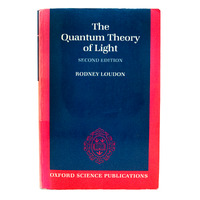 Book "The Quantum Theory of Light"
 When Stefan Hell read a section in this book, it opened up a new way of thinking. For many years, he had pondered the possibility of circumventing the theoretical boundary that limited the size of objects visible through a microscope. His idea met scepticism in Germany, so he left for Turku, Finland. While in Turku, he read this book about quantum optics. Reading about stimulated emission, the basis of laser technology, he had a new idea. This led to the development of a new form of microscopy that gave more detailed images than had previously been thought possible.
Stefan Hell donated the book to the Nobel Prize Museum in 2014.
-
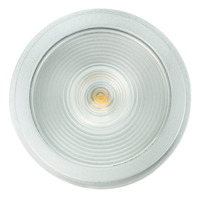 LED lamp
 Even after completing his Nobel Prize-awarded work on blue-light-emitting diodes (LEDs), Shuji Nakamura has continued to research this field. This LED lamp is an example of a later generation of LED lamps that Nakamura has helped to develop.
Shuji Nakamura donated the LED lamp to the Nobel Prize Museum in 2014.
-
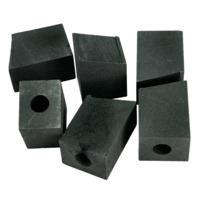 Graphite
 Graphite, one of the forms in which pure carbon occurs, has played a part in many vital experiments. Together with his mentor, Isamu Akasaki, Hiroshi Amano worked doggedly to produce extremely pure crystals of gallium nitride. He used these pieces of graphite as a base and applied a layer of sapphire, followed by layers of gallium nitride.
Hiroshi Amano donated the graphite to the Nobel Prize Museum in 2014.
-
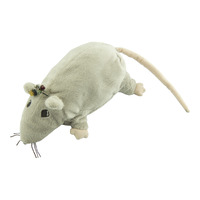 Toy rat with electrodes
 Using very thin electrodes to measure nerve impulses in the cells of rats' brains May-Britt Moser and Edvard Moser succeeded in mapping the brain’s navigation system.
May-Britt Moser och Edvard Moser donated the electrodes and the toy rat to the Nobel Prize Museum in 2014.
-
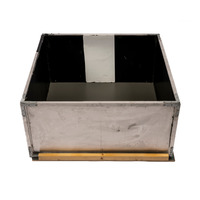 Cage
Cage May-Britt Moser and Edvard Moser explored how rats navigate by letting them move around in this box. By registering a rat’s position and the impulses in different cells in its brain, they succeeded in mapping the brain’s navigation system.
May-Britt Moser och Edvard Moser donated the box to the Nobel Prize Museum in 2014.
-
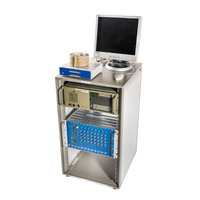 Laboratory equipment
 May-Britt Moser and Edvard Moser used this electronic equipment to simultaneously register a rat’s position and the nerve impulses in the cells of the rat’s brain. The experiments aimed to understand how humans and animals find their way.
May-Britt Moser och Edvard Moser donated the laboratory equipment to the Nobel Prize Museum in 2014.
-
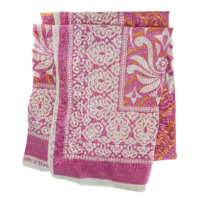 Scarf
Scarf This shawl was worn by Malala Yousafzai on her 16th birthday on 12 July 2013, when she held a speech at the UN Headquarters in New York. Powerfully and persuasively, she conveyed her message – that all children have the right to schooling and education. Books and pencils are the mightiest weapons in the fight against poverty and terrorism.
Even as an eleven-year-old, Malala Yousafzai was campaigning for girls' right to education. When two men affiliated with the Taliban regime tried to kill her in 2012, her fight became internationally famous.
Malala Yousafzai donated the shawl to the Nobel Prize Museum in 2014.
-
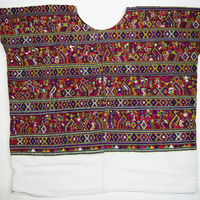 Blouse
 Rigoberta Menchú Tum has received many traditional blouses, “huipil” or “güipil”, as gifts on her visits to different parts of her home country, Guatemala. Menchú Tum has fought for the rights of indigenous people in her country. They belong to the Mayan people, who speak different languages and dialects. Their blouses vary from region to region in Guatemala. This blouse is from the Maya Ixil people in the Ixil region, next to Uspantán, where Rigoberta Menchú Tum was born and grew up. She herself is Maya Quiché.
Rigoberta Menchú Tum donated the blouse to the Nobel Prize Museum in 2014.
-
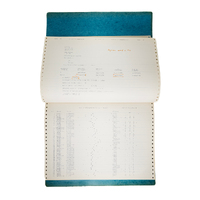 Computer output
 These computer printouts show data and calculations behind a 1981 pioneering study on the rise and fall of share prices by Robert Shiller. In contrast to the dominating idea at the time, he showed that stock prices fluctuated much more than corporate dividends. Shiller’s conclusion was that the market is inefficient.
Robert Shiller donated the computer output to the Nobel Prize Museum in 2014.
-
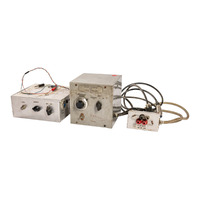 Apparatus
 These metal boxes contain electronics and have been part of the equipment in Keffer Hartline's laboratory at Johns Hopkins School of Medicine in Baltimore, Maryland. Hartline studied how the signals from photoreceptor cells are processed in networks of neurons. The electronics in the boxes were used to amplify the electrical signals from the neurons. The devices were built by Ted MacNichol, who was Hartline's first graduate student. When the devices were no longer used in the laboratory, Hartline took them home so his sons could use them in school projects.
The apparatus was donated to the Nobel Prize Museum by Keffer Hartline's family in 2014.
-
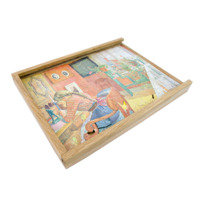 Jigsaw puzzle
 Hugo Theorell made this puzzle at the age of 15 out of a painting by Swedish artist Carl Larsson. At school, Theorell was very interested in woodwork and crafts. Using a jigsaw of his own design, he became skilled at making jigsaw puzzles. By selling them, Theorell paid for violin lessons at home in Linköping and, later, trips to Stockholm for more lessons and other studies. He was a talented violinist, but an even better chemist, receiving the 1955 Medicine Prize for his work on enzymes.
The puzzle was donated to the Nobel Prize Museum by Hugo Theorell’s family in 2014.
-
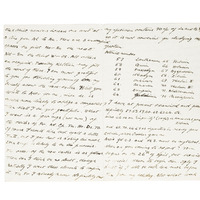 Letter from Henry Moseley to George de Hevesy
 This letter was written in 1914 by the young physicist Henry Moseley to George de Hevesy, who many years later would be awarded the 1943 Nobel Prize in Chemistry. Moseley talks about his investigations of various elements and asks for help in obtaining samples of various elements.
Moseley used X-ray diffraction to study the spectra of different elements and found a relationship between the wavelengths of X-rays and the element's atomic number. This allowed the periodic table to be revised and supplemented.
Moseley's life came to a tragic end when he was killed in the First World War in August 1915. Could his discoveries have resulted in a Nobel Prize? Yes, probably. Svante Arrhenius nominated him for the Nobel Prize in both Physics and Chemistry in 1915. In presenting a later Nobel Prize in a related field, the 1924 physics prize to Manne Siegbahn, Nobel Committee Chairman Allvar Gullstrand said: "Moseley fell at the Dardanelles before he could be awarded the prize... ". Gullstrand said that Moseley's work, however, had drawn the committee's attention to Charles Barkla, who was awarded the 1918 physics prize for his work on the X-ray spectra of atoms.
The letter was presented to the Nobel Prize Museum by the Hevesy family in 2000.
-
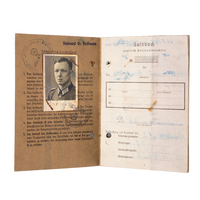 Soldbok
 En soldbok är en militär lönebok och identitetshandling. Denna soldbok har tillhört Werner Forssmann, som vid andra världskrigets utbrott 1939 blev militärläkare i tyska krigsmakten. Han avancerade så småningom till majors grad. Forssmann hade blivit medlem i nazistpartiet 1932 och förblev medlem till 1945. Vid krigsslutet hamnade han i ett läger för krigsfångar. Efter sin frigivning arbetade han som skogsarbetare och sedan som distriktsläkare.
Soldboken donerades till Nobelprismuseet av Werner Forssmanns efterlevande 2014.
-
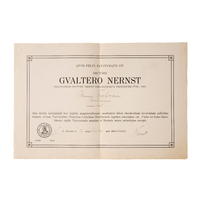 Antagningsbevis
 Hösten 1922 fick den 18-årige Werner Forssmann besked om att han antagits till läkarutbildningen vid Friedrich-Wilhelms-Universität zu Berlin (numera Humboldt-Universität zu Berlin). Antagningsbeviset är skrivet på latin och undertecknat av universitetets rektor Walter Nernst, Nobelpristagare i kemi 1920.
Werner Forssmann skulle många år senare, 1956, tilldelas Nobelpriset i fysiologi eller medicin för sina pionjärinsatser inom hjärtmedicin.
Antagningsbeviset donerades till Nobelprismuseet av Werner Forssmanns efterlevande 2014.
-
 Bläckhus
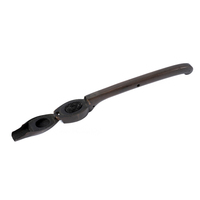
 Werner Forssmann fick någon gång under 1930-talet detta bläckhus av en japansk läkare. Enligt hans dotter var gåvan mycket viktig för honom, annars hade han inte ansträngt sig för att bevara bläckhuset genom de turbulenta åren under andra världskriget.
Bläckhuset donerades till Nobelprismuseet av Werners Forssmanns efterlevande 2014.
-
 T-shirt
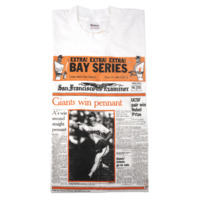
 T-tröjan visar förstasidan av tidningen San Francisco Examiner den 9 oktober 1989, dagen efter tillkännagivandet av att Michael Bishop tillsammans med Harold Varmus tilldelats Nobelpriset i fysiologi eller medicin. Nyheten om Nobelpriset till de två forskarna vid University of California San Francisco var uppenbarligen en viktig nyhet. Av utrymmet att döma dock inte lika viktig som segrarna för San Francisco Giants och Oakland Athletics i det pågående slutspelet i Major League Baseball.
Michael Bishop donerade tröjan till Nobelprismuseet 2014.
-
 Book by Tomas Tranströmer
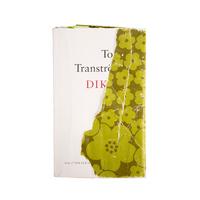
 Boken bakom omslaget innehåller dikter av Tomas Tranströmer och användes av Peter Englund under arbetet med Nobelpriset i litteratur 2011. Det halvt borttagna bokomslaget berättar att arbetet med att välja Nobelpristagare är strikt sekretessbelagt. Englund använde bokomslaget för att dölja vad han läste i olika sammanhang. Han var vid tiden Svenska Akademiens ständiga sekreterare och skulle därmed tillkännage beslutet för media. Strax efter tillkännagivandet kunde Englund riva bort omslaget från boken som han bar på sig vid tillfället. I boken finns en lapp med telefonnumret till Tranströmers hem, anteckningar Englund gjorde när han förberedde sig för att berätta om beslutet, samt en lapp med de exakta formuleringar han läste upp vid tillkännagivandet.
Boken donerades till Nobelprismuseet av Peter Englund 2014.
-
 Eyeglasses
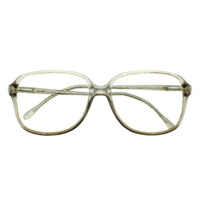
 These glasses belonged to Seamus Heaney. They were donated to the Nobel Prize Museum by his wife Marie Devlin, who recalls one occasion when he was wearing them: In October 1995, when he received the phone call informing him that he had won the Nobel Prize in Literature.
The glasses were donated to the Nobel Prize Museum by Marie Devlin in 2014.
-
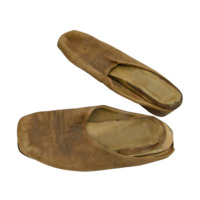 Leather slippers
 Tawakkol Karman sees her shoes as a symbol of how she is continuing her fight for democracy and human rights.
Tawakkol Karman donated the shoes to the Nobel Prize Museum in 2014.
-
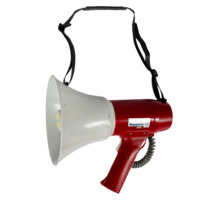 Megaphone
 This megaphone was the first one Tawakkol Karman used when calling for democracy and human rights. Many protests erupted against incumbent regimes in Arab countries during the Arab Spring in 2011. In the Yemeni capital, Sana'a, journalist and activist Tawakkol Karman led demonstrations against her country's regime. When she donated the megaphone to the Nobel Prize Museum she said: “I would like to give you my voice.”
Tawakkol Karman donated the megaphone to the Nobel Prize Museum in 2014.
-
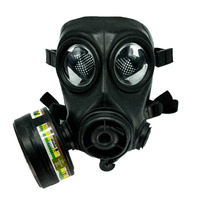 Gas mask
 A gas mask can provide protection against chemical warfare. The use of chemical weapons has long been banned, but they are still used. Civilians are usually the ones who suffer the most. The Organisation for the Prohibition of Chemical Weapons (OPCW) makes use of international cooperation to help eliminate chemical weapons.
After a visit to the Nobel Prize Museum by the organisation's Director General, Ahmet Üzümcü, the OPCW donated this gas mask to the museum.
OPCW donated the gas mask to the Nobel Prize Museum in 2014.
-
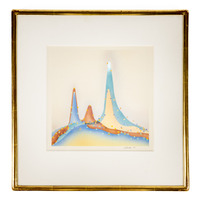 Painting
 This painting is an artistic representation of a diagram in a ground-breaking scholarly article by Susumu Tonegawa.
To fight all viruses, bacteria and other damaging substances that we can be exposed to, we need the capacity to produce enormous amounts of different antibodies. The production of antibodies is controlled by genes, but the number of genes is much smaller than the number of antibodies that can be produced. In 1976, Tonegawa showed how this was possible. The genetic material in B cells, a type of white blood cell, can move and form new combinations, while B cells can convert to produce antibodies.
Susumu Tonegawa donated the painting to the Nobel Prize Museum in 2013.
-
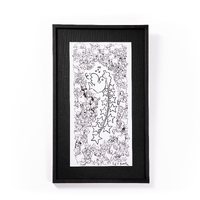 Artwork by Plantu
 To commemorate the occasion of being awarded the Nobel Peace Prize, the European Union decided to let make a commemoratory poster. The basis for the poster is artwork by Plantu, Jean Plantureux, a French cartoonist specialized in political satire. The artwork, which is shown here, has as a motif a peace dove with the stars of the EU in its beak, amidst celebration and all the flags of the EU.
The European Union donated the poster to the Nobel Prize Museum in 2013.